
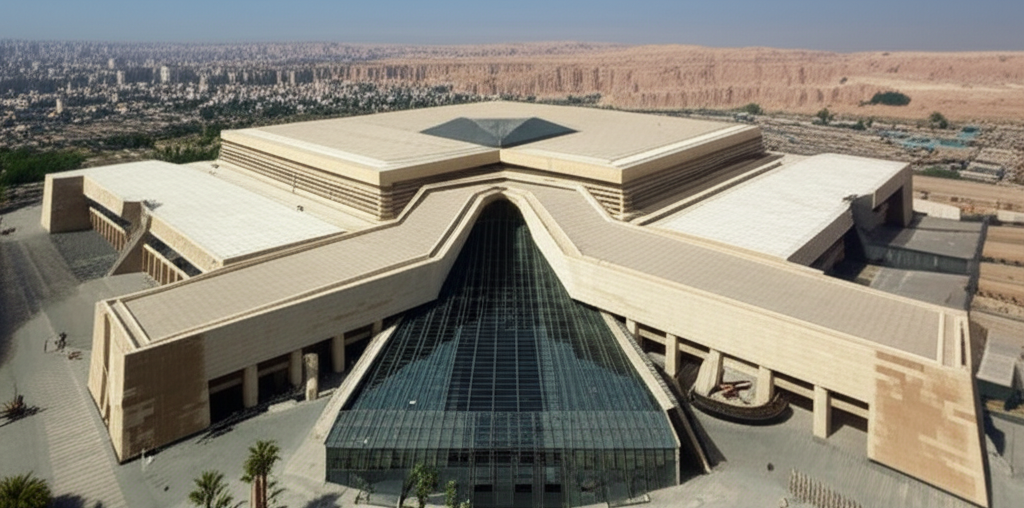
Grand Egyptian Museum to open fully in Giza
Cairo — Egypt’s long-awaited Grand Egyptian Museum (GEM) is set to open in full to the public, National Geographic reported, marking a major milestone for the country’s cultural sector and tourism industry. Located on the Giza Plateau west of Cairo, the new complex will offer comprehensive access to its galleries and facilities for the first time, including the full display of the famed Tutankhamun collection.
What’s happening
National Geographic said the museum is “opening in full,” signaling the transition from limited preview access and special events to full public operations. The museum, adjacent to the Pyramids of Giza, has been billed as one of the world’s largest archaeological museums devoted to a single civilization. Its centerpiece attractions include the complete assemblage of artifacts from the tomb of Pharaoh Tutankhamun—more than 5,000 objects—presented together for the first time.
The museum’s soaring atrium houses a colossal statue of Ramses II, while its signature Grand Staircase leads visitors past monumental sculptures toward galleries that trace Egypt’s history from prehistoric times through the Pharaonic and Greco-Roman eras. The complex also includes conservation laboratories, educational spaces, restaurants, retail areas, and expansive vistas toward the Giza pyramids.
Visitor details highlighted
According to National Geographic’s report outlining “what you need to know,” the full opening will standardize visitor access across galleries and services. Travelers can expect modern security screening, on-site amenities, and curated wayfinding throughout the vast complex. The publication noted practical guidance for prospective visitors, including how to plan time inside the museum, what highlights to prioritize, and what to expect upon arrival.
While Egyptian authorities have staged trial visits and soft-opening experiences in recent months, the National Geographic report indicates the museum is now moving to full-capacity operations. Visitors are advised to check official channels for final ticketing information, hours, and any timed-entry requirements as the museum scales up to steady daily attendance.
Why it matters
The GEM’s full opening is a landmark cultural development for Egypt. Bringing the Tutankhamun collection together in purpose-built, climate-controlled galleries is expected to set new standards for the display and interpretation of ancient Egyptian heritage. The museum’s location—just a short distance from the Great Pyramid and the Sphinx—offers a unified visitor experience that connects the country’s most iconic archaeological landscape with a state-of-the-art exhibition hub.
Tourism officials have long anticipated that the GEM will serve as a powerful draw for international travelers, complementing ongoing improvements around the Giza Plateau and Cairo’s museum ecosystem. The facility’s conservation center and education programs are also positioned to strengthen research and preservation efforts for Egyptian antiquities.
Background and timeline
The Grand Egyptian Museum has been under development for years, with construction and fit-out progressing in phases as collections were transferred, conserved, and installed. During this period, the museum hosted limited-access previews and special exhibitions to test visitor flows and showcase key spaces. National Geographic’s latest report indicates the transition from these partial openings to full public access, a step long awaited by the global museum community and Egypt’s cultural sector.
Architecturally, the complex features a contemporary design that incorporates desert-inspired geometry and materials, framing views toward the pyramids. Inside, the galleries are organized chronologically and thematically, with attention to accessibility, lighting, and interpretation to support both casual visitors and specialists.
What visitors can expect next
As the GEM moves into full operations, travelers should monitor official museum communications for ticketing options, entry times, and any special exhibitions or programming tied to the opening. National Geographic’s guidance emphasizes planning ahead, allowing ample time to navigate the expansive campus, and prioritizing must-see areas such as the Tutankhamun galleries, the Ramses II colossus in the atrium, and the monumental statuary along the Grand Staircase.
The museum’s full opening is expected to add momentum to Egypt’s tourism recovery and reinforce the country’s position as a premier destination for archaeology and heritage tourism. With the GEM now poised to welcome visitors at scale, Egypt is preparing to showcase its ancient past in a facility designed for the twenty-first century.