
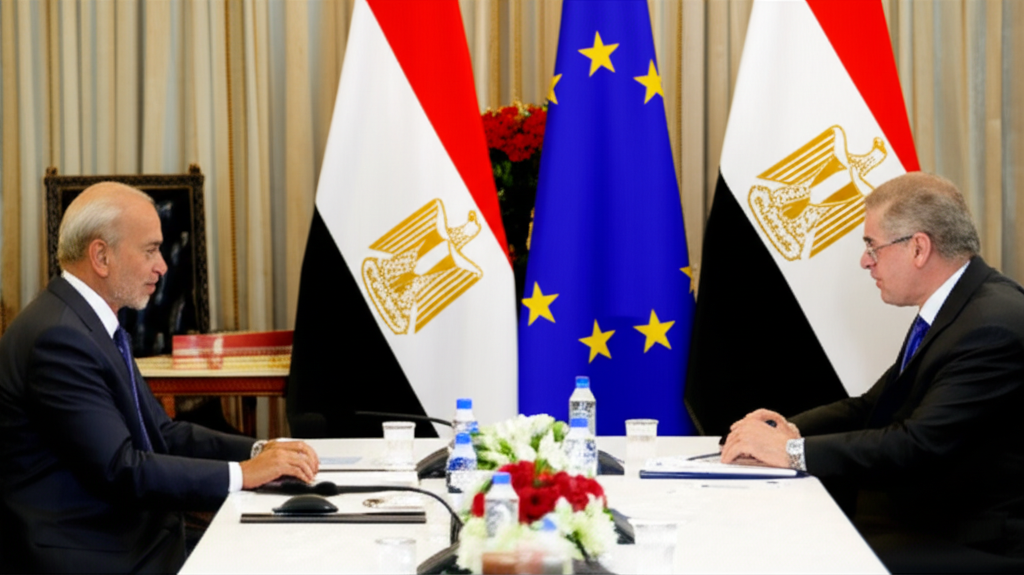
Egypt, EU hold talks; UAE signs aviation pacts
Cairo — Egypt moved to strengthen its external partnerships this week, with officials discussing ways to foster a joint partnership with the European Union and signing aviation pacts with the United Arab Emirates to deepen regional cooperation, according to reports by the Egyptian Gazette and Gulf News.
Egypt and EU discuss fostering joint partnership
The Egyptian Gazette reported that Egypt and the European Union discussed steps to “foster a joint partnership,” underscoring Cairo’s ongoing engagement with Brussels on economic and strategic priorities. While specific measures were not immediately disclosed, the talks align with a broader agenda to enhance cooperation across trade, investment, energy and mobility.
The discussions come as Egypt and the EU continue to follow through on a strategic framework announced in March 2024, when both sides unveiled a comprehensive partnership package aimed at supporting economic stabilization, private-sector growth, and energy transition in Egypt. The framework, which centers on investment, renewable energy, and migration management, has provided a platform for regular technical dialogues and sector-focused coordination.
Egypt’s outreach to the EU reflects a push to attract investment, expand export markets and advance infrastructure projects, including in green hydrogen and electricity interconnection. For the EU, deeper ties with Egypt are seen as vital for supply-chain resilience, energy security and regional stability in the Southern Mediterranean.
UAE and Egypt sign aviation pacts
In a separate development, Gulf News reported that the UAE and Egypt signed aviation pacts designed to “deepen regional cooperation.” The agreements are intended to bolster civil aviation collaboration between the two countries, supporting connectivity and facilitating the movement of people and goods.
While details of the pacts were not specified in the report, such agreements typically cover areas including air transport services, safety oversight, air navigation, training and capacity building. Strengthened cooperation can help streamline regulatory coordination and improve operational efficiency for carriers operating between the two markets.
Air links between Egypt and the UAE are among the most heavily trafficked routes in the Middle East, serving business travelers, tourists and expatriate communities. Enhanced aviation cooperation is expected to support route development, increase service reliability and create opportunities for joint initiatives in aviation safety and technology.
Context and implications
Together, the developments signal a dual-track approach by Cairo to deepen its ties with both European and Gulf partners. Engagement with the EU builds on a long-standing economic relationship and the post-2024 partnership agenda, while the aviation pacts with the UAE reinforce practical cooperation in a critical sector for trade, tourism and investment.
Egypt’s broader objectives include stabilizing its macroeconomic environment, attracting foreign direct investment, and expanding employment in logistics, manufacturing and services. By anchoring cooperation with the EU and the UAE, Egypt aims to leverage financing, technical expertise and market access to accelerate growth and modernization.
For the EU, a stronger partnership with Egypt supports shared interests in regional stability, energy diversification and managed mobility. For the UAE, enhanced civil aviation ties with Egypt complement wider economic collaboration across infrastructure, logistics and tourism, and may catalyze additional private-sector projects connecting the two economies.
Next steps
Officials did not immediately release timelines or technical annexes related to the talks and agreements reported. Further announcements are expected as working groups convene to translate the partnership discussions with the EU into sector-specific programs and as civil aviation regulators in Egypt and the UAE detail the scope of new cooperation measures.
As these initiatives progress, industry stakeholders will watch for updates on aviation safety cooperation, training and route development, as well as EU–Egypt projects in energy, transport and investment that could yield near-term economic benefits.
The latest moves emphasize Egypt’s focus on practical, partnership-based engagement with key regional and international counterparts, aiming to unlock capital, improve connectivity and underpin sustainable growth.